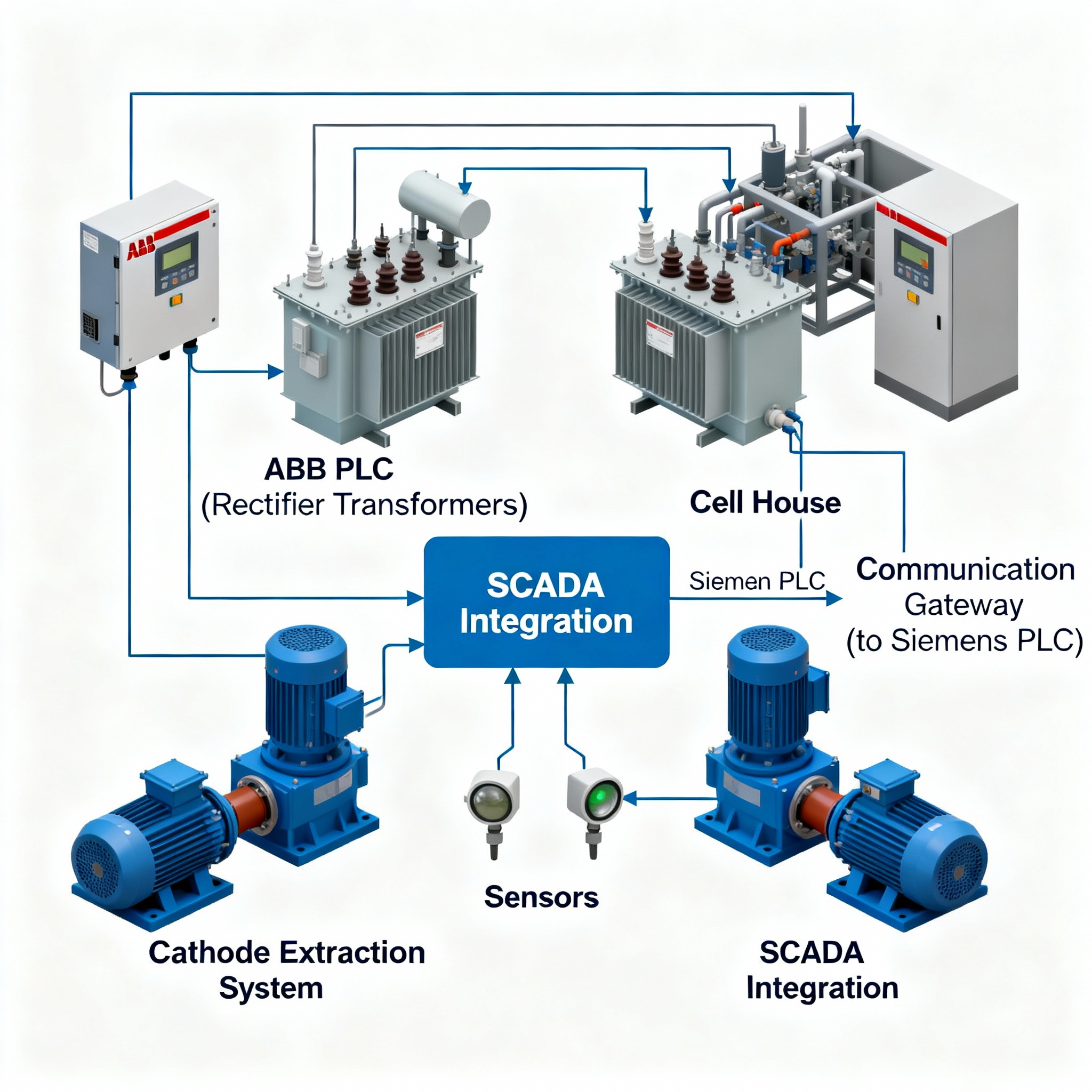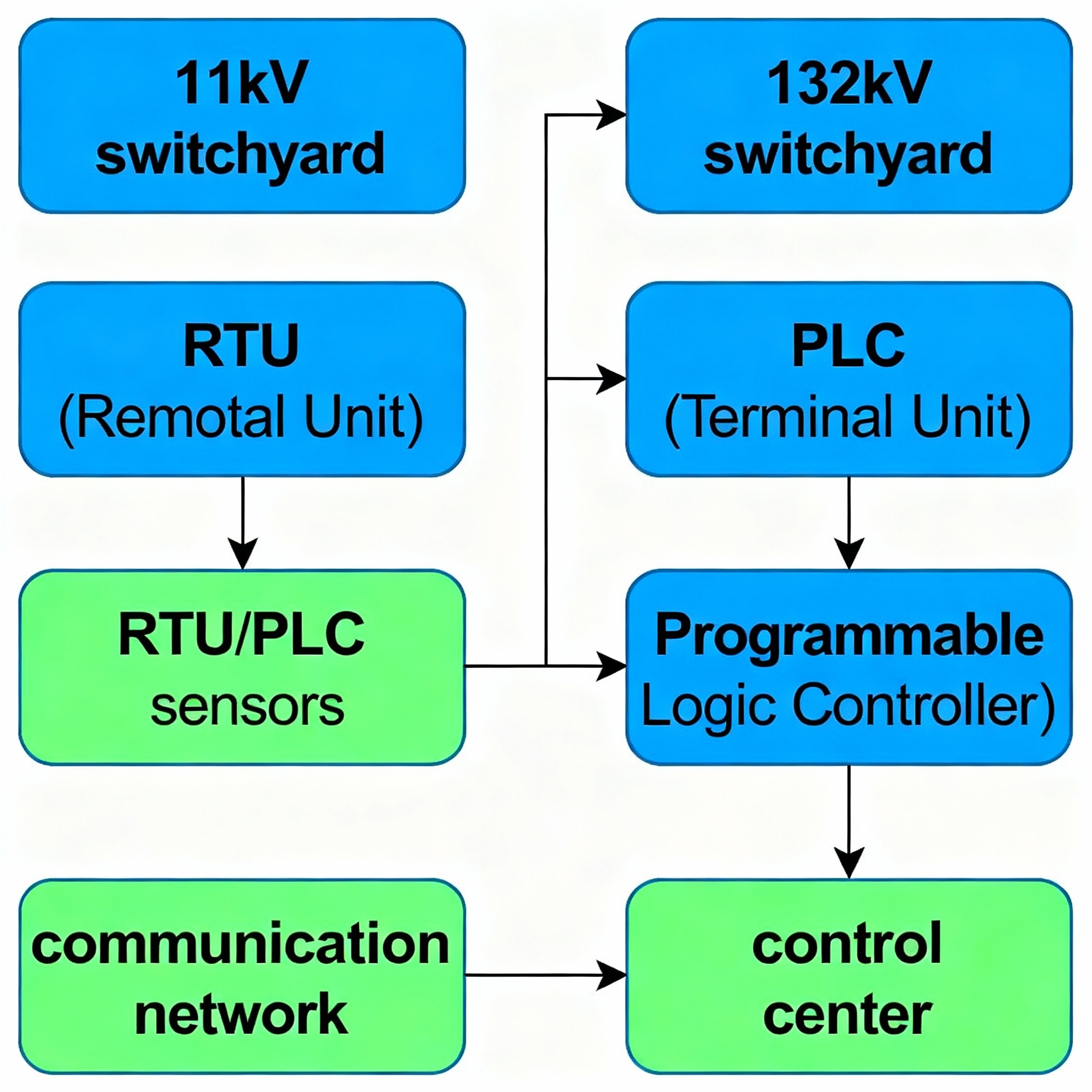
SCADA systems play an essential role in 11kV and 132kV switchyards by providing centralized monitoring, control, and automation of power equipment, leading to greater reliability, safety, and efficiency within substations. These systems use networks of sensors, Remote Terminal Units (RTUs), Programmable Logic Controllers (PLCs), and Human-Machine Interfaces (HMIs) to remotely supervise and operate circuit breakers, isolators, power transformers, CT/PTs, protection relays, and auxiliary systems.
Use Cases in Switchyards
- Remote Equipment Monitoring: Operators monitor real-time voltage, current, power factor, and equipment status across the switchyard from a central control room, improving situational awareness and enabling swift decision-making.
- Fault Detection and Protection: SCADA systems trigger alarms, execute automatic tripping via protection relays, and isolate faulty lines or equipment, ensuring faster response to faults and reduced downtime.
- Automatic Switching Operations: Circuit breakers and isolators can be operated remotely or programmed for automatic control based on system logic, providing improved operational flexibility and safety.
- Data Logging and Reporting: SCADA records all electrical parameters, switchgear operations, protection relay actions, and fault events for historical analysis, troubleshooting, and regulatory compliance.
- Preventive Maintenance: Continuous monitoring of electrical parameters helps identify deteriorating conditions (e.g., high temperature, abnormal currents), supporting predictive maintenance strategies.
- Load Shedding and Demand Management: In substations supplying critical loads, SCADA is used to automatically shed or restore loads in response to predefined conditions, maintaining grid stability.
- System Integration: SCADA in switchyards integrates with other utility management systems like Energy Management Systems (EMS), supporting wide-area grid visibility and control.
Typical Integration and Popular SCADA Platforms
For 11kV/132kV switchyard automation, SCADA systems are most commonly integrated with server-based platforms and industrial PLCs/RTUs. Leading SCADA solutions used in switchyards include:
| SCADA Platform | Key Features | Use Case Highlights |
|---|---|---|
| Siemens SIMATIC WinCC | Web-based HMI, scalable architecture, extensive diagnostic tools | Widely used in utility substations, flexible for integration with Siemens PLCs |
| Rockwell FactoryTalk | Modular design, centralized monitoring, real-time information sharing | Utility and industrial substation automation, seamless integration with Allen-Bradley PLCs |
| Schneider Wonderware | Advanced data analysis, visualization, batch and process control | Integration with multiple field platforms and legacy systems |
| ABB Ability System 800xA | High reliability, sophisticated alarm management, multi-vendor protocol support | Complex switchyard and grid applications |
| Honeywell Experion | Secure, real-time control, MES/ERP integration | Critical utility and grid management |
| GE Cimplicity | Distributed architecture, reporting, process management | Power generation and distribution substations |
| Emerson DeltaV | Integrated operator interface, high-speed data logging | Reliable for transformer yard integration |
Summary
SCADA systems in 11kV and 132kV switchyards automate and supervise all critical power equipment, ensure fast fault response, allow remote and automatic switching, and provide comprehensive data analytics for stable, safe, and reliable grid operation. Widely integrated platforms include Siemens WinCC, Rockwell FactoryTalk, Schneider Wonderware, ABB Ability, Honeywell Experion, GE Cimplicity, and Emerson DeltaV, each offering strong interoperability and advanced monitoring capabilities for substation environments.