

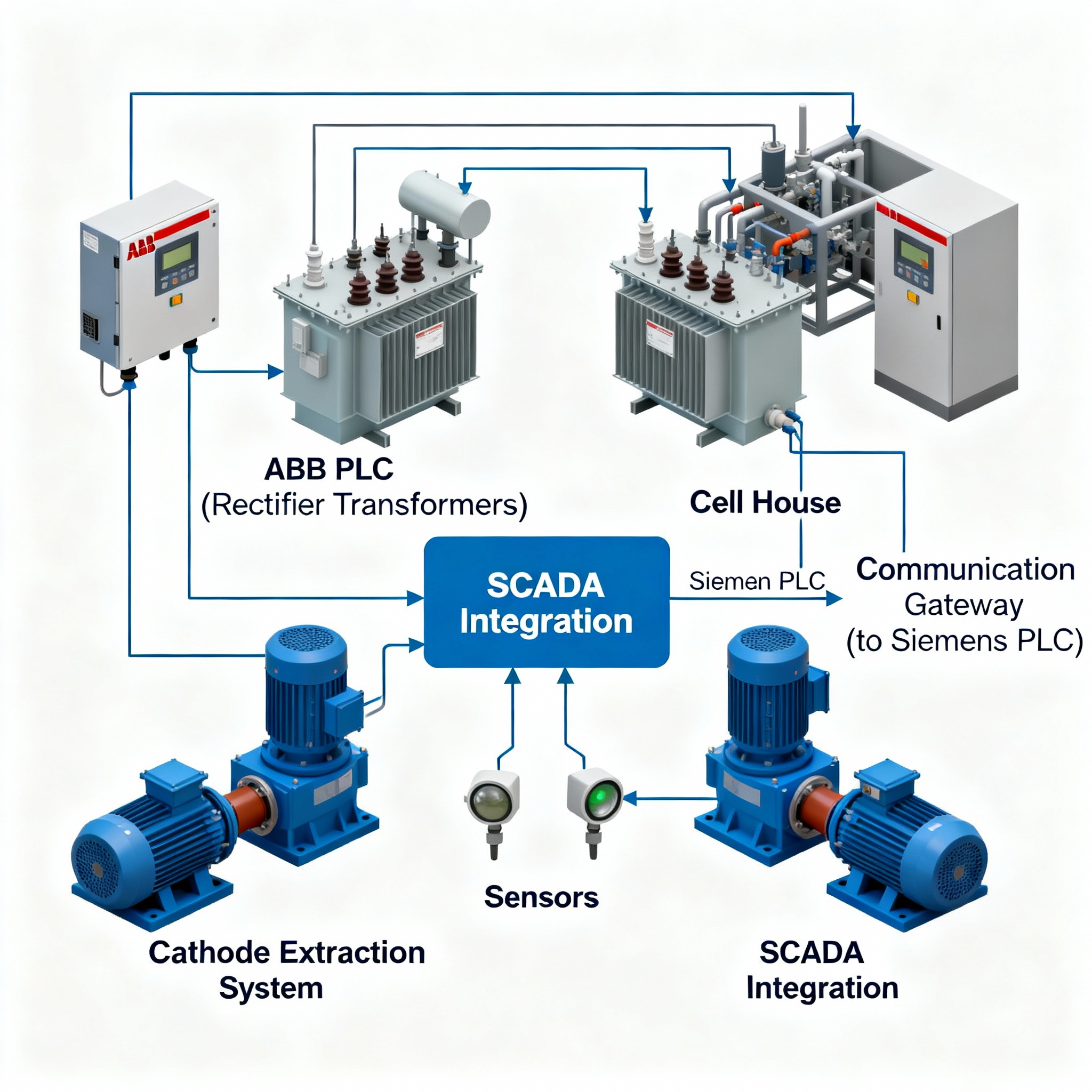
In a zinc extraction unit, automation typically involves ABB PLCs controlling the rectifier transformers that supply DC power to the electrolytic cell houses and Siemens PLCs managing material handling systems like robotic cathode extraction. Reliable, real-time communication between these PLCs is essential for safe and synchronized zinc extraction operations.
Process Overview
- Rectifier Transformer and Cell Charging
- The ABB PLC manages rectifier transformers responsible for converting AC power to controlled DC power, which is used to charge the electrolytic cells in the cell house. Optimal current and voltage are maintained based on feedback from process sensors and quality parameters to ensure efficient zinc deposition on cathode plates.
- The ABB PLC handles interlocks, safety trips, continuous voltage/current regulation, and transformer protection.
- Cathode Extraction and Siemens PLC
- Once zinc is sufficiently deposited, the Siemens PLC controls a robotic or mechanical system that automatically extracts cathodes from multiple cell houses.
- Siemens PLC logic manages the movement of overhead cranes, transfer cars, cathode stripping machines (CSM), and material conveyors. The PLC ensures the synchronization of extraction cycles, safety interlocks, and movement sequences for reliable zinc retrieval.
- Communication Between ABB and Siemens PLCs
- Inter-PLC communication is needed to coordinate cell charging and extraction, such as signaling when extraction can proceed without disrupting charging or causing unsafe voltage drops.
- Communication can be established using industry protocols like PROFIBUS DP, PROFINET, or Modbus TCP/IP. Commonly, a DP/DP coupler or protocol gateway (from either ABB or Siemens) bridges the two PLCs, allowing high-speed, deterministic data exchange for process synchronization.
- ABB AC800M PLCs can support interfacing modules like CI871 (Profinet), CI854 (Profibus), or generic Modbus cards. Siemens S7-300/400/1200/1500 PLCs can be configured with communication processors to match the chosen protocol.
- Supervisory Control
- A SCADA or DCS system collects data from both PLCs for visualization, historical logging, remote operator control, and process optimization
Hardware Involved
| Area | Typical Hardware Components |
|---|---|
| Rectifier Cell House | ABB PLC (e.g., AC800M with I/O modules), rectifier transformer panels, process sensors (current, voltage, temperature), protection relays, HMI panel for local operation |
| Cathode Extraction Area | Siemens PLC (S7-300/400/1200/1500), digital/analog I/O, VFD drives for motors, position sensors, encoders on cranes/robotics, limit switches, CSM, conveyors, local HMI |
| PLC Communication | Protocol gateway (e.g., DP/DP coupler, Profinet I/O device module), communication CPUs (CP modules), networking cables (Ethernet or Profibus), safety relays for interlocks |
| Supervision & Control | SCADA/DCS server, operator workstations, SCADA communication interface cards, network switches, remote displays |
Complete Process Sequence
- The ABB PLC first ensures the cell house is charged, maintains stable DC output, and signals the Siemens PLC when a batch is ready for cathode removal.
- Siemens PLC executes the extraction, stripping, and handling sequence using the automated equipment, while also feeding back completion and safety status to the ABB side.
- All data and alarms from both PLCs are integrated into the central SCADA/DCS for operator supervision, alarm handling, and process data analysis.
By combining ABB’s robust process control for electrical equipment with Siemens’ advanced automation for material handling, zinc extraction units achieve optimized operations, higher yields, and increased personnel safety, while ensuring seamless interoperability through established industrial protocols and communication hardware.
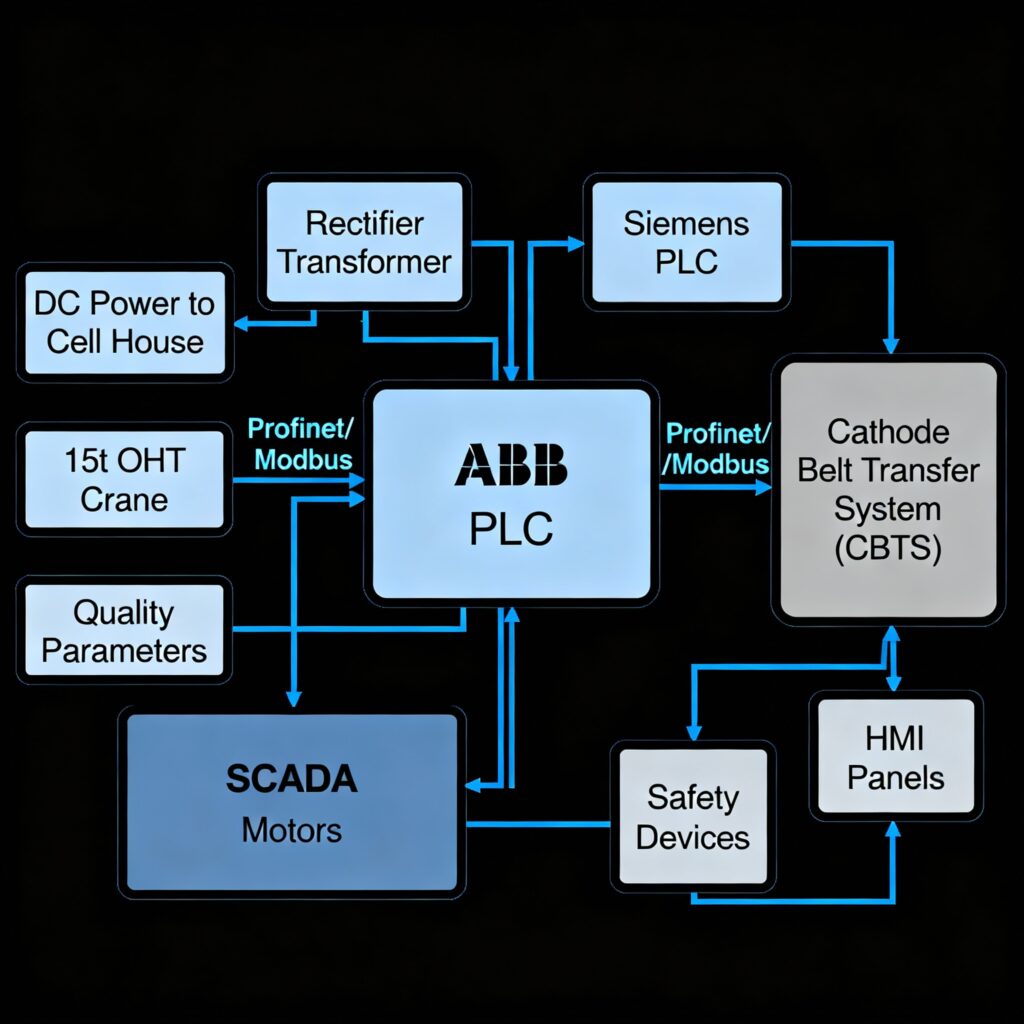
In this zinc extraction automation system, the Siemens PLC is responsible for controlling the 15-ton Overhead Traveling (OHT) crane operation which moves cathode plates between the cell area and the Cathode Belt Transfer System (CBTS). The OHT crane picks up the cathode plates containing deposited zinc from the electrolytic cell house and transports them to the CBTS, where zinc is extracted from these plates. After zinc extraction, the OHT crane returns the cleaned cathode plates back to the cell house, only after validating their quality parameters such as thickness, integrity, and purity, by interfacing with inline sensors or quality measurement devices connected to the Siemens PLC.
Simultaneously, the ABB PLC manages the DC power supply to the cell house by controlling the rectifier transformers. This involves regulating voltage and current flow through the transformer to ensure consistent and optimal charging of the electrolytic cells. The ABB PLC continuously adjusts parameters based on real-time feedback from sensors for current, voltage, and temperature, implementing protective interlocks to safeguard the transformer and the cells.
The two PLC systems communicate closely, exchanging status signals and command information to synchronize crane movements with cell charging activities. This coordination prevents operational conflicts, thereby increasing process efficiency and safety. The overall automation system also integrates with a SCADA or DCS platform for centralized monitoring, data logging, and operator interventions.
Key Components:
- Siemens PLC: Controls OHT crane motion, cathode transfer, quality checks using sensors, and conveyor interface at CBTS.
- ABB PLC: Controls rectifier transformer for DC power regulation to electrolytic cells.
- OHT Crane: Heavy-duty crane with servo motors and position encoders.
- CBTS: Mechanized zinc stripping system linked to crane and PLCs.
- Sensors and Quality Devices: Thickness gauges, temperature sensors, and defect detectors connected to Siemens PLC.
- Communication Link: Industrial protocols (Profibus, Profinet, or Modbus TCP) for PLC interlocking and data exchange.
- SCADA/DCS: Supervisory control and data acquisition system for integrated operation and monitoring.
This system architecture ensures seamless zinc extraction cycles with precise coordination between heavy equipment movement, power supply control, and quality verification, enhancing overall plant productivity and safety.
In this zinc extraction automation system, the ABB PLC controlling the rectifier transformers and the Siemens PLC managing the 15t OHT crane and Cathode Belt Transfer System (CBTS) communicate bidirectionally to optimize zinc deposition on the cathode plates.
Communication and Data Exchange
- Quality Parameter Sharing: The Siemens PLC collects quality parameters of the cathode plates after zinc extraction using sensors and measurement devices at the CBTS. These parameters include metrics like thickness, purity, and surface integrity, which indicate the efficiency of zinc deposition and quality of the cathode plate.
- Data Transmission: Siemens PLC transmits these measured quality parameters to the ABB PLC using industrial communication protocols such as PROFINET, Modbus TCP/IP, or PROFIBUS. This communication is typically facilitated through communication modules, gateways, or direct Ethernet-based connection depending on system setup.
- Deposition Rate Control: Upon receiving the quality data, the ABB PLC adjusts the DC current delivered by the rectifier transformers, modulating the zinc deposition rate in the electrolytic cells to ensure optimal plating without over-deposition or defects.
- Coordinated Process Control: The ABB PLC feedback to the Siemens PLC includes updated current and voltage setpoints or alarms related to power supply parameters. The Siemens PLC uses this information to appropriately schedule cathode extraction cycles, aligning with deposition status.
- Safety and Efficiency: This real-time data feedback loop enables precise control of zinc plating thickness and quality, improves electrolyte utilization, reduces waste, and enhances overall plant safety by avoiding overcurrent or suboptimal plating conditions.
- System Integration: The communication framework is supported by a SCADA/DCS system that aggregates and visualizes process data from both PLCs, facilitating operator supervision, alarms management, and historical data analysis for continuous process improvement.
This synchronized PLC communication strategy is critical to maintaining product quality, reducing maintenance, and ensuring high-efficiency zinc electrowinning operation.
| Sr. No | Item Description | Typical Model / Specification | Quantity | Remarks |
|---|---|---|---|---|
| 1 | ABB PLC Controller | ABB AC800M CPU with I/O modules | 1 | For rectifier transformer control |
| 2 | Siemens PLC Controller | Siemens S7-1500 CPU with I/O modules | 1 | For OHT crane and CBTS control |
| 3 | Communication Modules for ABB PLC | ABB CI871 (Profinet), CI854 (Profibus) | 1-2 | For communication with Siemens PLC |
| 4 | Communication Modules for Siemens PLC | Siemens CP 1543/1243 Profinet/Ethernet module | 1 | For communication with ABB PLC |
| 5 | Industrial Ethernet Switches | Managed switches with STP, Gigabit ports | 2-3 | For PLC and SCADA network connectivity |
| 6 | Rectifier Transformer Panel | High power rectifier transformer with sensors | 1 | Includes voltage/current/temp sensors |
| 7 | Sensors for Transformer & Cell House | Current sensors, voltage sensors, temp sensors | Multiple | For feedback to ABB PLC |
| 8 | I/O Modules (Digital/Analog) | Manufacturer specific, matching PLCs | As required | For sensor and actuator interfacing |
| 9 | Servo/AC Motors & Drives for OHT Crane | Siemens or ABB motor/drives package | 1 set | With position encoders and VFD |
| 10 | Position Sensors / Encoders | Rotary/linear encoders suitable for crane axes | Multiple | For accurate crane positioning |
| 11 | Safety Devices | Emergency stops, light curtains, safety relays | Multiple | To ensure operator and equipment safety |
| 12 | HMI Panels | Allen Bradley PanelView or Siemens Comfort Panel | 2 | For local and operator control |
| 13 | CBTS Control System Components | Conveyors, actuators, level sensors, etc. | As required | Integrated with Siemens PLC |
| 14 | SCADA System Server & Workstations | SCADA software license and hardware | 1 set | For supervisory monitoring and control |
| 15 | Network Cables and Accessories | CAT6 Ethernet cables, optical fibers as needed | Multiple | For reliable high-speed industrial communication |
| 16 | Power Supplies and UPS | Industrial power supplies and backup | 1 set | For PLCs, sensors, and control devices |
| 17 | Protocol Gateway (if required) | DP/DP coupler or Ethernet gateway | 1 | To enable communication between ABB and Siemens PLC if direct is not possible |
yes ethernet communication is the most suitable way to communicate
Hi, can we have more discussion about this?
We agree with points you mentioned in the blog
Zinc extraction is critical process